
Switching to LiFePO4 batteries solved a lot of things at once — more usable capacity, faster charging, no fear of deep discharge. But it also brought along one problem I hadn't fully thought through in advance: the original Iveco alternator was designed to charge the starter battery and handle a smaller load, not to push current at full strength into a large LiFePO4 bank right after the engine starts.
LiFePO4 batteries can actually accept charging current much more aggressively than gel or lead-acid — but only if the charging source has enough power to make use of that. Without modification, the alternator would have been the limiting link in the entire system.
Why the original alternator wasn't enough
The factory alternator is sized for the vehicle's normal consumption — lights, steering, onboard electronics, and charging the starter battery. But a large-capacity LiFePO4 traction bank needs significantly higher current while driving if it's to be charged in a reasonable time. Without a more powerful source, the DC-DC chargers would only have a fraction of what they could otherwise process available to them.
So the solution wasn't just replacing the batteries, but the entire charging chain while driving — from the alternator all the way to the DC-DC chargers.
How I found the right alternator
The logical first step was the OEM parts catalogue. It showed one approved replacement: a 150 A Bosch alternator, essentially the same spec as factory-fitted. That wasn't what I was looking for — I was rebuilding the entire electrical system and putting the same specification back in made no sense.
After more research I came across the Bosch 180 A. Mechanically it fit the Iveco Daily engine and the specs listed LIN bus support — same as the original. It looked like a straightforward swap, so we fitted it.
After starting up, the charging warning light on the dashboard came on. The alternator was generating current and the batteries were charging, but the BCM (Body Control Module) didn't recognise it. The problem: LIN bus support alone isn't enough — every manufacturer uses its own communication mapping, and this alternator had a different protocol than what Iveco's control unit expected. The van kept reporting a fault even though the alternator was physically working at full output. A classic case of components doing exactly what they're supposed to, but not talking to each other.
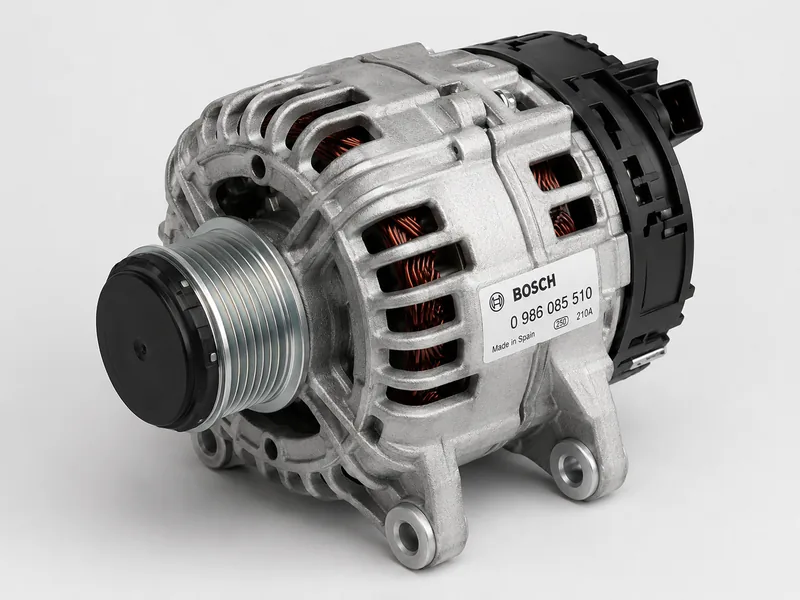
I went back to square one. This time I searched not just for output and mechanical fit, but for the specific LIN communication implementation for Iveco. After a few days studying technical databases and foreign forums, two candidates emerged: Bosch 210 A (0 986 085 510) and HC Cargo F 032116 722. Both were reportedly using the correct mapping for Iveco's control unit. Not wanting to risk another unnecessary disassembly, I ordered both.
We fitted the Bosch 210 A first. After starting — no warning light, no fault. The BCM recognised it immediately, LIN communication worked, and charging started exactly as from the factory — only this time Phoenix had a 210 A Bosch with significantly more headroom instead of the worn-out 150 A unit. The HC Cargo F 032116 722 stayed as an untested backup. We replaced the freewheel pulley and drive belt at the same time — with an alternator of this output it makes sense to start with a new belt rather than wait until something breaks.
Two Orion-Tr Smart DC-DC chargers
Between the alternator and the traction bank, I installed two Victron Orion-Tr Smart chargers — an isolated 12/12-30 A unit for the main circuit and a non-isolated 12/12-50 A unit as a supplement. The isolated version keeps the starter and traction circuits electrically separated, while the non-isolated one adds extra current where galvanic isolation isn't necessary. Together they handle charging while driving far better than a single unit could on its own.
Both chargers also communicate via Bluetooth and VictronConnect, so I can see the charging curve and the current draw on my phone, not just estimate it.
How it all works together
The alternator, the two DC-DC chargers, and the Victron LiFePO4 bank now form a single chain that charges the batteries while driving genuinely faster than the original gel-based system ever could. In practice, this means that after a few hours of driving the bank is full again, even if I drained it pretty hard the night before — fridge, lights, both air conditioning units. Charging on the move now actually works in practice, not just on paper.
Components used
- Bosch 210 A alternator, OEM 0 986 085 510 — compatibility and technical data
- Victron Energy Orion-Tr Smart 12/12-30 A Isolated — specifications
- Victron Energy Orion-Tr Smart 12/12-50 A Non-Isolated — specifications
- Victron Energy LiFePO4 Battery NG — specifications
- Alternator freewheel pulley — replaced together with the alternator
- Iveco Daily drive belt — replaced preventively during installation
Frequently Asked Questions
Why wasn't the Bosch 180A enough in the Iveco Daily if it supports LIN?
LIN bus support on its own isn't enough. Every alternator manufacturer implements its own communication mapping, and the Iveco body control module (BCM) has to recognise that specific mapping. The Bosch 180A used a different protocol from the one the BCM expected — so the vehicle kept reporting a charging fault even though the alternator was physically working. The only reliable approach is to verify the specific OEM compatibility, not just the presence of a LIN interface.
Why isn't the stock alternator enough for LiFePO₄ batteries?
The stock alternator is designed for the starter battery and standard onboard loads. A large LiFePO₄ bank accepts charging current far more aggressively — without a more powerful alternator, the DC-DC charger is needlessly throttled and charging while driving takes too long.
How does the Victron Orion-Tr Smart DC-DC charger work?
The Orion-Tr Smart is a DC-DC converter that isolates the starter and traction circuits and regulates charging current precisely for LiFePO₄ chemistry. The isolated version also provides galvanic separation; the non-isolated version adds more current where separation isn't needed. Both units are monitored via Bluetooth and VictronConnect.
Do I need to replace the alternator when switching to LiFePO₄, or is a DC-DC charger enough?
A DC-DC charger alone is sufficient if you don't need to charge a large bank quickly. If you have 200 Ah or more and want to realistically replenish it during a few hours of driving, a higher-output alternator makes a significant difference — in Phoenix the Bosch 210 A added tens of amps over the original.
How many amps does a LiFePO₄ bank need for reasonable charging while driving?
It depends on capacity. For a 200 Ah LiFePO₄ bank, 30–60 A is reasonable; for 400 Ah, 60–100+ A. In Phoenix, two Orion-Tr Smart units deliver over 80 A combined — 3–4 hours of driving returns most of the energy used overnight.